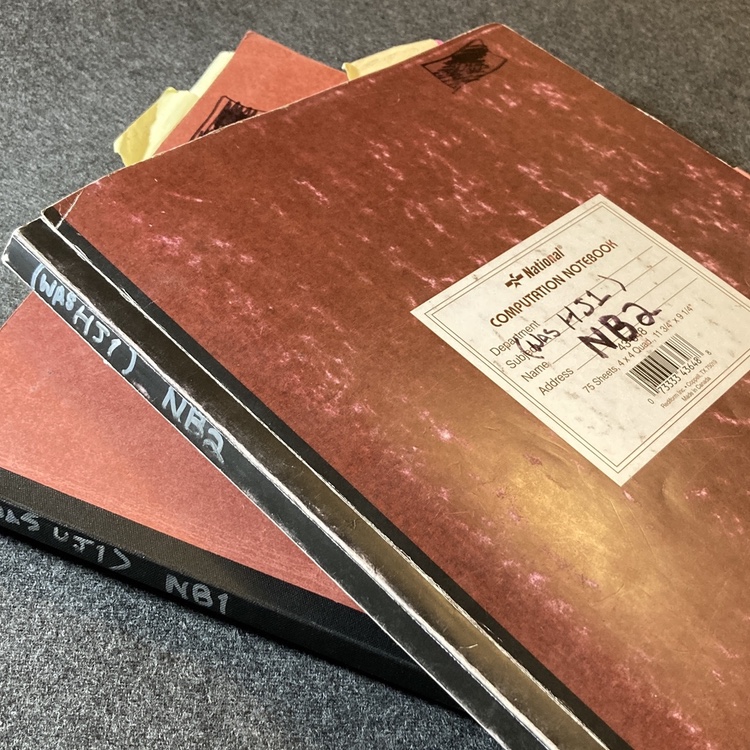
You could write in anything. Why do I specifically recommend lab notebooks?
Because they’re designed to solve a specific problem: how do you keep track of what you’re figuring out when you don’t yet know what matters?
Scientists use lab notebooks because experiments don’t always work. Most of the time you’re trying things that might fail. You need a record of what you tried, what happened, and what you thought about it—even the stuff that didn’t work. Especially the stuff that didn’t work, because that’s often where the actual learning is.
Your work is the same way. You’re trying things. Some succeed, some don’t. You’re figuring things out as you go.
Here’s what makes lab notebooks work:
Chronological order. Everything goes in date order. You don’t have to decide where something “belongs.”
Numbered pages. You can reference things later. “See p47” is useful. “That thing I wrote somewhere” is not.
Permanent record. Bound notebooks mean you can’t rip out pages or reorganize. This sounds like a limitation, but it’s a feature. You can write messy thoughts without worrying about making it pretty later.
There is no “later.” There’s just what you wrote and what you write next.
ɕ
This is part of a series about Hand-Write. Think Better.—a method for people who feel overwhelmed to start simply writing more on paper. Get the book →