One slip at a time

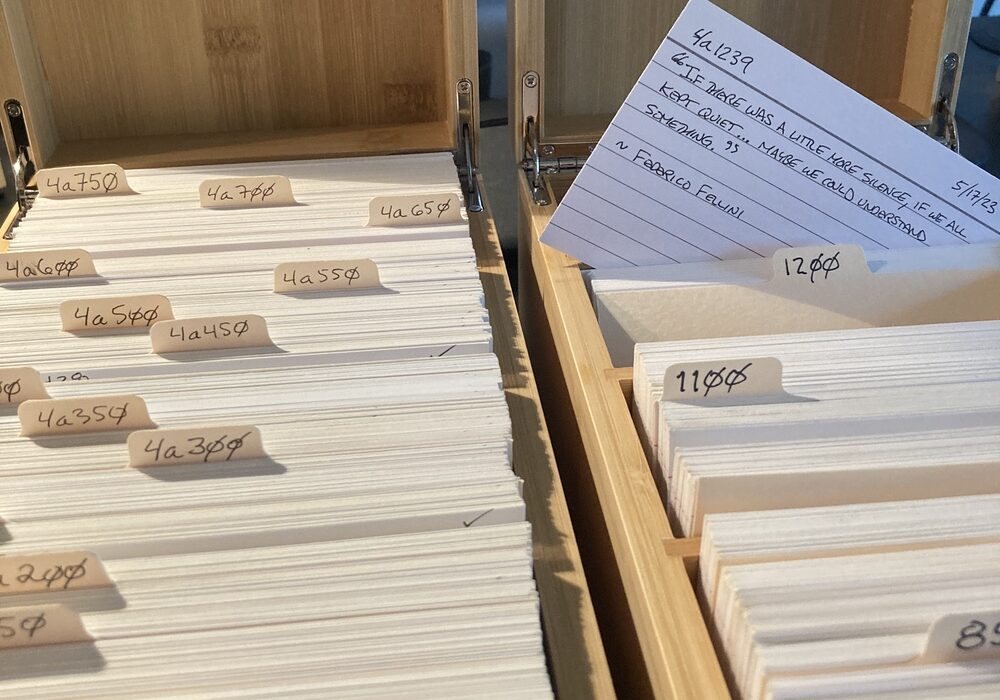
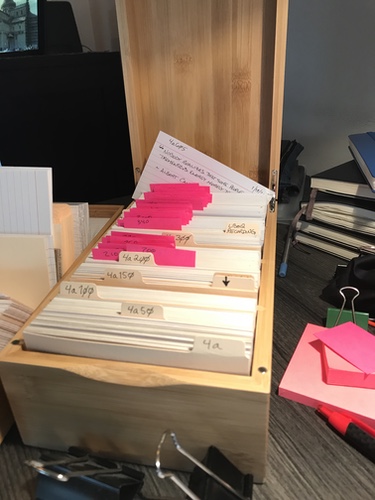
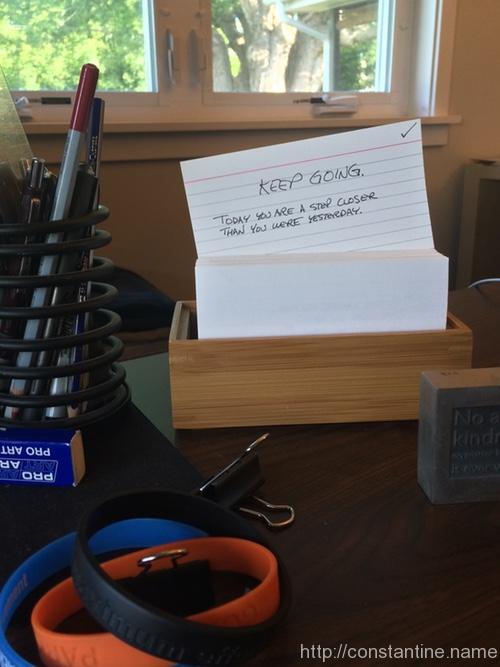
This morning I was working on adding some quotes to the ‘ol collection. I have a little box with the most-recent quotes, blank 3×5 cards and other little office-supply-ish things. Every now and then I pick up a bunch of those new quotes and move them back into these boxes. Today I realized, the second of these boxes is now nearly full—it seems like only yesterday that I moved the first few inches of cards (like ~400) into the first box. Time to order more of these storage boxes!

ɕ


How do you personally evaluate whether your podcast is working for you?

There’s no correct answer to this question. The only important thing is that each of us takes the time to find our own answer. This is not a “set it and forget it” situation: You have to reconsider this question periodically too.

Yesterday I was talking with a podcaster who is in the middle of a significant pivot of their show. Why the pivot? It wasn’t working for them any more.

I’ve pivoted shows, started new shows, intentionally stopped publishing episodes of a show, and completely deleted shows from existence. Each time because there was a clear sign (often a sign I’d been in denial about) that the show was no longer working for me.

That’s what you have to figure out for yourself.

I did 1,400 episodes of Little Box of Quotes as a daily show. I had specific things I was practicing. When creating new episodes became a thing I started avoiding, I stopped. A year later, I’m thinking of resuming publishing the show, but my reasons for publishing it are now completely different.

I’ve tried two different show-formats for the Open + Curious podcast. Now in 2025, I’m scheduling guests for its 3rd season which will be in my signature style of conversation.

The Movers Mindset podcast hasn’t been the same format since day one. There’s been a bunch of experiments within that show. As I have new ideas, and new questions about what can a recorded conversation be, that’s where I’ve done most of my experimentation.

Even Podtalk has changed over time. What began as “the companion podcast to the Podcaster Community” (conversations with the community’s members) expanded to conversations with any independent podcast creator.

As I said: There’s no one, correct answer for everyone. There isn’t even one, correct answer for each of us!

ɕ


What is intention?

Friend and fellow podcaster Angie Flynn-McIver published a book, Before You Say Anything, in 2021…

Your intention should be something that really lights you up. You need to feel it in your chest, in your gut. It is the verb that connects you to your audience, the umbilical cord that takes your energy to them and brings theirs back to you. Intention is action.

~ Angie Flynn-McIver

slip:4a1471.

Another quote from the book, was a seed for a recent post to Open + Curious

Little Box of Quotes — For those who don’t know: The quote at the top is now included in my collection, which I call the Little Box of Quotes — number 1,471 to be exact. There’s a daily email available with just exactly one quote, and nothing more. For several years it was also a daily podcast which to more than 1,000 episodes (still available wherever you listen). All free, just because I like to create things that make the world a better place.

ɕ


Why someone else writes

From a very early age, perhaps the age of five or six, I knew that when I grew up I should be a writer. Between the ages of about seventeen and twenty-four I tried to abandon this idea, but I did so with the consciousness that I was outraging my true nature and that sooner or later I should have to settle down and write books.

~ George Orwell, from Why I write

slip:4uoete1.

Back in 2021 I added this quote to my collection. (I have an ever-growing collection of ~1,500 quotes, which are available as a daily, random, quote-by-email from https://littleboxofquotes.com.) Anyway.

I found it interesting that here I am, 3 years later and my instinct was to pick this exact same bit of text to quote. It feels reassuring that my “what should I pick?” process is reproducible. Also interesting: What I’ve quoted are Orwell’s opening words. For most things I quote, it’s something in the middle that leaps out at me. So perhaps, in addition to showing us why he’s also making a point about how he writes: Start with the good stuff, and then get on to the even better stuff.

ɕ


Little Box of Quotes

I didn’t set out to collect quotes. I simply wanted to randomly be inspired, or challenged to think, by things others have said or written.

…and 30 years later, I now get a little email from my past self every day. No noise. Just a quote. https://littleboxofquotes.com/

In 1994 I began collecting inspirational quotes, displaying them randomly on my personal blog. After a few years I copied them all onto 3×5 cards. I put them in a small box and continued to add cards. Today, there are more than 1,500 quotes and the collection continues to grow.

ɕ


wait wat?

This community’s value proposition is about more than being the Hacker News or reddit for travel. The focus is squarely on quality.

~ Anuj Adhiya from, «https://cmxhub.com/outbounding-hook-model/»

Yes, please. Based on that statement alone, I’d want to be a part of this sort of community.

The basic idea is that, to create habit-forming communities, you must move a user through a loop that over time will help them develop a habit of returning and contributing to the community. It looks like this: A trigger, internal or external, drives a user to the platform where they get some sort of variable reward, contribute something of their own, and return to the platform later for the same loop.

~ ibid.

Uhmmm… (That slight-squint with slightly-sideways, dubious look happens here.) Habituation is not, per se, a good thing. I agree that it is important to understand how what’s said there actually works; I often talk about the Oxo® handles we all have sticking out of our psyches. The ability to generate a habit in someone else is clearly one such handle.

A community comes into extence from the network of interpersonal relationships. A community isn’t, simply by its existence, a good thing. Also, if those relationships form because of habituation to come to the community space, that still doesn’t mean the community is a good thing. And we don’t even need habituation in order to form those interpersonal relationships. Yes, we may be able to “hack” those relationships into existence via habituation, but there are other ways to encourage those relationships.

I want to be part of communities that understand the nature of the interpersonal relationships, and the effect a community has as a whole. I want to be part of communities where those things are actually positive goods.

ɕ


What information consumes

In an information-rich world, the wealth of information means a dearth of something else: a scarcity of whatever it is that information consumes. What information consumes is rather obvious: it consumes the attention of its recipients. Hence a wealth of information creates a poverty of attention and a need to allocate that attention efficiently among the overabundance of information sources that might consume it.

~ Herbert Simon

slip:4a767.

It may be, as he says, obvious to Simon, but it really was not obvious to me. Until I read this I had always thought of myself as giving, or perhaps spending, my time on information. In recent years I’ve begun reminding anyone who’ll listen, that we all have large Oxo grips that extend from the ancient systems cobbled together which today form our intelligence, our fear, and our psyche. It’s easy to grab someone by those handles and lead them. That’s fine because everyone doesn’t try to grab me by those Oxo handles. But software is good at grabbing those handles. Hardware is good at it. And companies run by people who haven’t thought through the morality of what they’re building using software and hardware are really good at it.

So when I read Simon’s comment about information consuming my attention. I sat bolt-upright.

…and then I renewed by efforts to swat away anything that I catch gazing lasciviously at my weaknesses.

ɕ


Quiet

I maintained this illusion until, inspired by a stupidly expensive device that only does one thing, I taped my old phone to a bluetooth keyboard and began to write in offline mode. It was immediately a magical experience. It was so *quiet*. I could go on my porch and write and it was quiet. My thoughts got much larger because I wasn’t subconsciously afraid I’d interrupt them. I began to feel angry at my laptop. Why did it insist on hurting me so much? Why couldn’t it be pure like the offline phone/keyboard experience? Why couldn’t I just create things?

~ “Elizabeth” from, Turns Out Interruptions Are Bad, Who Knew? — LessWrong

slip:4ulepo3.

Don’t worry, I’m not getting on my soapbox about distraction and being used by your phone and the Internet and social networks. Nope, definitely not getting on my soapbox.

Today, I’ve gotten my ladder and I’m climbing on my roof to preach right over your head—you nice people in my front lawn, who are smart enough to be reading, reading stuff that has paragraphs, from a site on the open web, even if you only subscribe to the email because you haven’t mastered RSS—nope not preaching at you, dearest choir of mine, not today.

But you people in the back… Can you not see the Oxo® easy-grip handles that extendeth from thine brains?! Can you not see the unwashed masses of people who labor for Facelessco et al to write software that grabs you by those handles?

What say you? WHAT? …sorry you have to yell, I can’t hear you so well from up here on my roof… Oh, you cannot in fact see the handles? …well, have you tried looking in the mirror? …uh, hello?! Where are you going? Oh yes, definitely check that message, and scroll through Instagram and I’ll just wait here on my roof.

ɕ