2L Erlenmeyer flask, $17 icluding shipping. College chemistry lab for the win! (I note my 750ml bottle of wine isn’t 750ml.)
ɕ
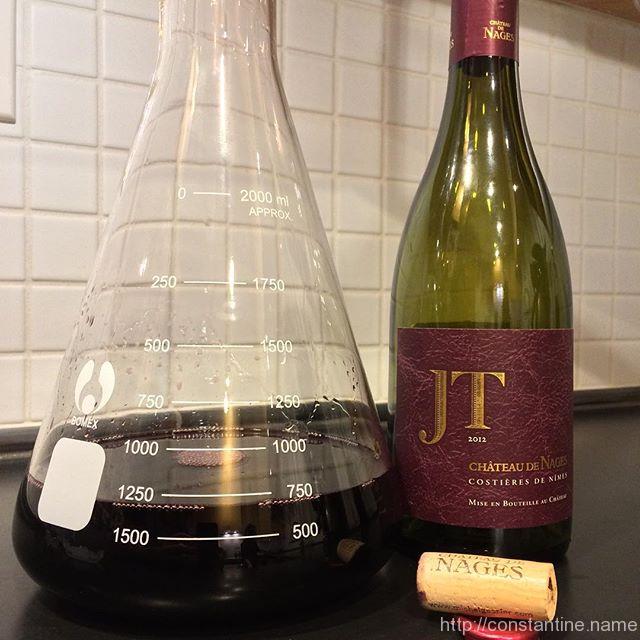
2L Erlenmeyer flask, $17 icluding shipping. College chemistry lab for the win! (I note my 750ml bottle of wine isn’t 750ml.)
ɕ
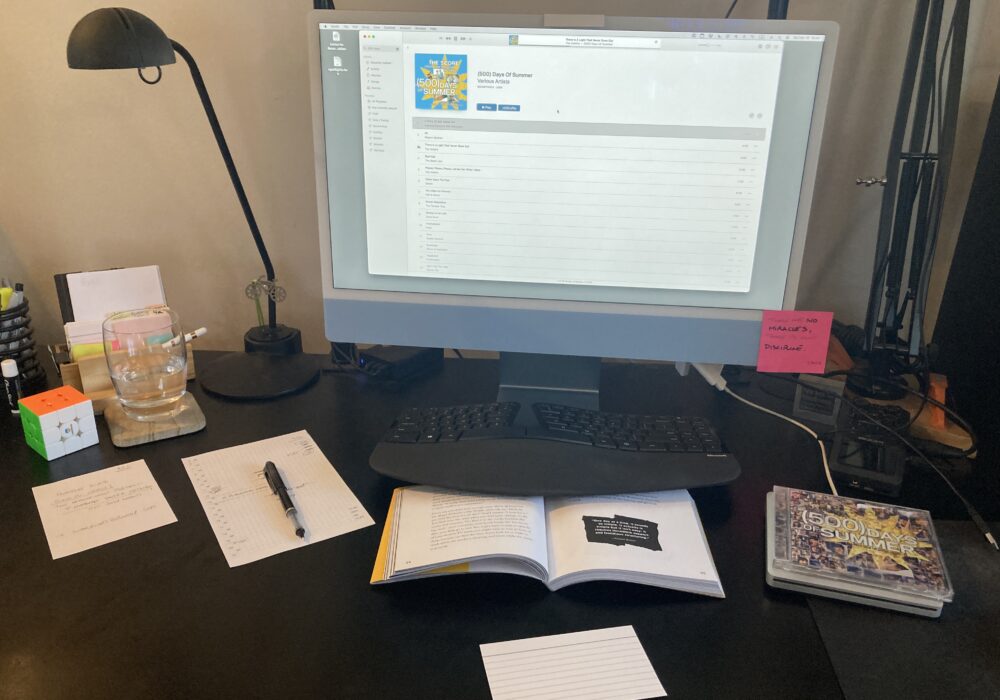
Taking a fresh look at Austin Kleon’s Show Your Work. Book is smashed open to a quote from Russell Brand—with a notecard where I’m about to add this quote to my collection. I’m a bit of an audio nerd—I don’t stream from services, rather stream from the countless CDs that I keep in the ‘ol digital library. I like to start from a movie soundtrack, and then spread out into all the artists. Rubik’s cube, glass of water. Pink postit reminds me: “There are no miracles, there is only discipline“
I write a lot about “looking back”. (A lot: 1, 2, 3, 4, 5 and 21 more posts, plus “looking back” has another 17 posts.) I clearly believe—I really do—that looking back is best for assessing things.
And yet… stress, unhappiness. (Important: Words left unsaid.)
By all objective metrics, I’m as successful today as I could hope to be a decade ago. I’m happily married, well inside the richest 1% globally, have found my tribe and earned some respect in it. I should be able to relax and take some satisfaction in my current situation. And yet the thought that in 5 years my life will look exactly like it does today fills me with dread.
~ Jacob Falkovich from, https://putanumonit.com/2019/08/15/unstriving/
My title is a nerdy reference to a small detail in the article. But it’s also a nerdy reference to how I feel that everything I write is simply derivative. Nonetheless, I’m looking back. I’m assessing my progress. I’m making some plans and I’m cutting red tape.
ɕ
No, this isn’t about AI. I mean the work that we want to do. That’s why only we can do it. I want to sift through a certain amount of things. (For example, I like to sift through all dogs.) I want to find things that are interesting and surprising. And I want to have way more books than I can ever read.
Because the meaning isn’t going to emerge on its own—you have to create it. The algorithms and tag searches and bookmarklets will only get you so far; afterwards, it’s work only you can do, work the machine has no need for. The reader is your own personal anthology, but you are the editor: you are the sum of its parts.
~ Mandy Brown from, https://aworkinglibrary.com/writing/three-definitions-of-reader
RSS Tip: Every Substack publication has an RSS feed. Go to the front of any Substack publication—the page after you ignore the sign-up dialog. Then copy the URL, and add /feed onto the end. (If the URL has an “?gobble-dee-gook” on it, trim that off before adding that /feed ) Add that edited URL to your favorite feed reader. (RSS nerds: Nope the RSS feed URL is not listed in any <link> tags. These are stealth feeds.) Ta-DAH! You’ll find the entire posts from the publication appear in your feed reader. This of course will only work until everyone starts doing it. Then Substack will modify those feeds to just be an excerpt of the article . . . and that’s still awesome, because that’s how web sites work on the Open Web. Protocols, not platforms.
ɕ
These stories illustrate two truths. 1) I’m a big ol’ nerd, and 2) the goodness and badness of memories fade over time, but the badness fades faster—that’s the fading affect bias. Some bad memories even become good memories, while good memories rarely become bad memories.
~ Adam Mastroianni from, https://www.experimental-history.com/p/underrated-ideas-in-psychology
Like Mastroianni, I’m clearly susceptible to this bias. One thing that I use to fight it, is to write myself honest thoughts after things happen. A lot of the pleasure from something is the anticipation—the imagining of the enjoyment from some expected experience. That’s pretty easy to remember to journal and it happens without effort in the days leading up. But after the fact, I usually take a big chunk of time and decompress. What did I really think when I got hit in the head that one time at that thing? …or when I fell? …or got sick? The best adventures are when I look back and think: “ugh, that sucked. I’m glad I did it.”
ɕ
Once I learned how to be a good sport, I began to appreciate getting my delusions busted as the target of a well played, real life, condescending Wonka. I’m too often condescending, and being the recipient is potent medicine.
It is to my great pleasure that such a fine example of 18th-century punking is related to typography.
~ Martin McClellan from https://www.mcsweeneys.net/articles/caslon-baskerville-and-franklin-revolutionary-types
Typography is a field which I find intriguing. People spent tremendous time and effort understanding readability and utility of little bits of lead type, printing presses, and optimizing everything. I find it sublime that someone so into type (go read the essay) was so oblivious about something they held so dear. Yes, do tell me more about that typography minutiae.
At which point I began doing that sort of squinting, glancing side to side, I’m feeling suspicious thing. I’m not a typography nerd, but there are a couple other fields where I could probably use a good punk’ing.
ɕ
I’m trying to sort out a problem concerning my slipbox: It’s not quite working the way everyone else claims it should. I’ve written a lot about my slipbox. Over the past 2+ years it’s grown to be about 1,000 slips (aka 3×5 cards) Plus the 1,200+ slips containing my collection of quotes.
I occasionally get a flash of inspiration and I sense the awesome power . . . and then it doesn’t happen again regularly. The problem has to do with how I’m putting things into the slipbox. This is a crucial point and (as far as I can find) it’s not often mentioned nor clearly explained. Everyone—including me—goes off into the weeds talking about how slips each get a unique address, how the addresses are fractal, etc. That’s classic systems-building nerd digression.
No the problem I have is, holding a slip with some idea on it, where do I put it? Literally, where is the specific spot in the collection of slips? …between which two existing slips do I place it?
What’s happened to me, is my slipbox is like a lawn: It has a wide collection of short blades of grass. It has few tall plants. There’s an amazing index of people, but each person usually has just one connection to something else in the slipbox. (For example: A podcast guest is usually only connected to the one slip for that conversation’s recording.) While I have hundreds of slips for my recorded conversations, they have almost no connections leading off from them. Again, I’ve a collection of ~100 slips for essays, books and other things I’ve put “into” the slipbox, and those cards have no other connections.
What I’ve built is what I build best: A large categorical archive. A library organized by thinking like a librarian. I’ve organized by topic or category. Here again, there’s a systems-building nerd digression into how you do that. But alas, it’s all just navel gazing structure for structure’s sake. Building a library is not sufficient. A good slipbox can be my library and enable me to find specific things. But a good slipbox is supposed to also let me do more. (It’s supposed to let me have a conversation with my previous thinking. It’s supposed to let my brain have ideas, while the slipbox let’s me explore all the ideas I’ve had.)
Instead of organizing by topic and subtopic, it is much more effective to organize by context. Specifically, the context in which it will be used. The primary question when deciding where to put something becomes “In which context will I want to stumble upon this again?”
In other words, instead of filing things away according to where they came from, you file them according to where they’re going. This is the essential difference between organizing like a librarian and organizing like a writer.
[…]
A writer asks “In which circumstances will I want to stumble upon this note?” They will file it under a paper they are writing, a conference they are speaking at, or an ongoing collaboration with a colleague. These are concrete, near-term deliverables and not abstract categories.
~ Tiago Forte from, https://fortelabs.com/blog/how-to-take-smart-notes/
After much thought—weeks of thinking, finding the above article, reading, more thinking… I’ve decided I have two problems. The second problem is the one I mentioned at the top: Where exactly do I put this specific slip? I’ve been fixated on this problem for a while, and the solution is above.
But the first problem is that I’m not generating enough slips. (Yes, I have 2,000+ slips in the slipbox. Yes, I’m serious about not generating enough slips.) I’m not capturing what slipbox builders call “literature notes” or “reading notes.” I’m not grabbing my pen and writing stuff down, right in the moment, as I’m thinking about something. I believe this started on day one, when I felt like I didn’t know where I would put such a slip (ie, the second problem) and off I went not making enough notes.
So my new focus is to jot stuff down more. Generate more literature or reading notes. At which point I should quickly get comfortable figuring out where to put stuff into the slipbox.
ɕ
slip:1b1a.
This is one of the main obstacles to forming habits. Our hopeful idea of how it will go, and then our disappointment and frustration with ourselves when it doesn’t go that way.
~ Leo Babauta from, https://zenhabits.net/perfectionism/
Nerd alert: I’ve always appreciated that Babauta takes the time to craft the URL paths (often called the “slug”) by hand. They’re not simply auto-generated from the titles of the posts. I love that this particular one, about perfectionism, has a single-word slug that contains the word “perfect”.
While writing this post I spun off to discover Grammar Monster. Yikes! Driven by my perfectionism, that’s the sort of thing that I could spend hours in. I backed away from it very slowly.
ɕ
“You don’t need [machine learning,]” Bryan said. “What you need is inverse Fast Fourier Transform.”
~ “Shift Happens” from, https://www.getrevue.co/profile/shift-happens/issues/moire-no-more-688319
I stumbled over a blog post, containing a pull-quote where someone mentioned inverse Fast Fourier Transform. (A mathematician named Fourier invented a fast way to do a certain sort of transformation that comes up a lot in science; It’s called a Fast Fourier Transform. There’s also a way to undo that transformation, called “the inverse”. Thus, Fast Fourier Transformations (FFT) and inverse FFT. Well, FFT/IFFT is the first thing I can recall that I could not understand. It was shocking. Every other thing I’d ever encountered was easy. But there I was, 20-some-years-old, in graduate school, and I encountered something that was beyond me. I think I had it sorted about 6 times and every time, the next morning, upon waking, it had fallen out of my head. Holy inappropriately long parentheticals, Batman!)
Anyway. Blog post. IFFTs. Time machine to the early 90s. Emotional vertigo.
…and then I clicked thru to the magnificent post which is brilliant. And then I realized the by-line was, “Shift Happens.” o_O This entire thing. I’m in nerd heaven.
ɕ
PS: Sorry, what? Oh, you read my title, heard the Italian word, “amore,” and wanted a, That’s Amore! pun? Okay, here: When an eel climbs a ramp to eat squid from a clamp… Yes. Really.
TK is an all-around mover, a dancer, rock climber, traceusse and earned her degree in athletic training. In addition to her movement practices, TK is a certified authentic Tantra instructor, teaching holistic healing of body, mind, spirit and sex. TK considers herself a sex activist and is the founder of LoveCraft, a sexual coaching and empowerment collective.
Tantra was the obvious place to begin since we were surely going to end up talking about tantric sex. My fear was that most people’s—myself included—knowledge of Tantra would be something to do with the artist, Sting. We immediately agreed that leaving the world only knowing about “men in linen pants” would be a disservice. “Tantra means, literally, to weave light and sound with form, the light being visualizations of your chakras in your body, sound being chants that you’re making, and then the form being your body, your physical body. That’s it, in a nutshell. The way that often looks is meditating. The way a lot of people do that is they’ll meditate and then have sex; they’ll meditate during sex; they’ll meditate on their own without any sex. Yeah, that’s kind of that, which means nothing, right? It’s like a, ‘Cool, and then what?’ which is what got me into having a coach.” — ~ TK from, ~4’40”
(more…)As autumn settles in where I am, I’ve been looking ahead to winter with longer nights, brisk days, etc.. I also looked back at the shape I’ve been in in years past. I’m not lamenting, “if only I had my youth back.” Rather, just thinking about health, movement, and what would be the minimum effective dosage of some exercise to move me in the direction I want. (That DuckDuckGo link should make you wonder why a medical-sounding phrase is used most relating to exercise not medicine, and strength training in particular.)
Sometimes—by which I mean any time running comes up—I say that running is both the best thing for me, and the form of activity I hate most. Both of which are untrue. What’s actually best for me is zone-2 aerobic exercise and that’s sometimes what I get when I run. It’s best for me, because that is the main driver of base fitness until you get well up into being a competent athlete. But usually, being quite over-weight at the moment, any running drives my heart-rate above the surprisingly low/slow zone-2. The second part about hating it is also untrue. It turns out that one time—the one single day apparently—that I was ever in shape, I enjoyed running. I was walking, the weather was beautiful, and I had an irresistible urge to run, (and so I did.) But, literally, that happened once.
Anyway. It’ll suffice to say: I spent a few weeks recently thinking about going full-on nerd with zone-2 training. To do it right requires planning, scheduling, and—sources vary—between 150 to 180 minutes exercising each week. And warm-up and cool-down time are not included in those weekly times. Honestly, the deal-breaker was I’m seriously pissed at FitBit, (and their watches are useless without a FitBit account,) and I refuse to spend many-hundreds on an Apple watch. Also, my $30 Timex is nicer, for my definition of “nicer.”
My thinking continued, and eventually I thought: I should just walk back from Mordor.
…except this time I’m not going to bother trying to track the actual mileage. Just walk as many days as I can. Listen to some podcasts some of the time. And basically just stroll along thinking, “If this isn’t nice…“
ɕ
So the worst-case scenario is someone who’s both naturally bitter and extremely ambitious, and yet only moderately successful.
~ Paul Graham from, http://paulgraham.com/fn.html
Graham is one of that vanishingly-rare type of blogger: One who posts stellar ideas, very infrequently and is being heard. Follow that link, take a trip back to the 90s-blogs, and learn something about nerds.
If I’m being honest, I’m not sure if I’m a nerd or a geek… I mean, I don’t actually know the definitions of those nouns. Sure, I can go look—here’s a good definition-and-how-to-tell… but the words simply don’t stick in my head as standing for something. Worse, I can tick boxes on both columns of that how-to-tell page. On the other hand, this page has a nifty graph and I think I’m over on the nerd side.
On the other, other hand, looking for “nerd” versus “geek” here on my own blog, isn’t very helpful. Maybe… just maybe… I was a geek, but there’s a natural half-life to Geeknadium, after which a certain percentage of geeks spontaneously transform into Nerdomium?
ɕ
It’s an idiosyncrasy to which we are dedicated. It’s nerdy fun, but it has a serious point, too. As our co-founder Stewart Brand points out: the present moment used to be the unimaginable future.
~ Mikl Em from, https://blog.longnow.org/02013/12/31/long-now-years-five-digit-dates-and-10k-compliance-at-home/
I’ll do the nerd stuff first: They take the leading zero in their representation of years so far, they’ve even figured out how to get it into their WordPress blog URLs. No, I’m not doing that. Yes, I am a supporting-member of The Long Now Foundation. And yes, of course I am on the waiting list to visit the clock they’re well-into constructing—in west Texas, I think it is?
I could easily wax obnoxious for a few thousand words rattling off a few things which are today blasé for me. But instead, I’d like you to hit reply and tell me: What’s something your primary-school-aged self would be astounded to learn about you?
ɕ
A few years ago, I read an article, Walking, by Steve Kamb about walking to Mordor and I set out to walk the round-trip 3,871 miles.
It’s 1,779 miles to get from Hobbiton to Mt. Doom. Then riding the eagles back to Minas Tirith cuts the return walk to Bag End down to 1625 miles. Plus 467 more miles, roundtrip to Grey Havens. Brings my total goal to 3,871 miles. This is roughly the entire length of the Nile river, or the distance from the surface to the center of the Earth. (Mid 2019 I’m a few hundred miles from Mt. Doom.)
https://constantine.name/2019/06/23/§10-walking-to-mordor/
As best I can tell, in 2014, I had already started walking the ~4-mile round-trip to my office, and I was using walking in general to improve my fitness for some specific parkour events I was planning to attend. When I found this challenge, I looked back through all my journals and estimated how far I’d already walked. In November 2016, when I took up the Mordor challenge, I noted that I had already walked 124 times for a total of 496 miles.
As I mentioned, walk number 500 turned out to be just 8 miles short of Mt Doom. But really, I’ve only been estimating my mileage based on measuring some common walking routes and counting the walks. So this is an amazing confluence of walk-number and mileage. So at this point, I’m going to stop keeping track of the mileage. (I do still keep track of general activity each day, so I still note “walk” when I do so.)
Take-aways?
Well, I think it’s amazing how far you can get—figuratively and literally—with small daily progress. Also, I think it’s very good for me mentally, given where I am at the end of 2019, to stop tracking this goal. It makes for one less thing on my mind.
I’m hoping that walking is now a way of life. I will note that I think absolutely nothing of walking a few miles. I’ve walked miles with a 40-pound backpack, (in minimalist sneakers.) I’ve walked 2 miles carrying 20 pounds of vegetables farmer-carry-style. I’ve fixed my back. I’ve fixed my feet.
Walk on!
ɕ
(Part 12 of 13 in series, Changes and Results)
Wow.
It took me years longer than I had originally hoped to finish this series of posts. I’ve recently decided to push these posts out the door so that they could possibly be of some use to others. Having them laying around as drafts-in-progress isn’t helpful.
As this series was being written, I took a terrific detour working with two friends who were experimenting with starting their own personal training company. They used me as a guinea pig for testing their coaching and training systems for nutrition, psychology of eating and physical training. During this time working with them I succeeded at some huge improvements in psychology (related to eating) and achieved the best physical condition I’ve been in in recorded history. If you want to do a deep dive, check out, Training for the New Alpinism.
…and a few other disjointed thoughts:
This: From Nerd Fitness, 5 Steps After Failing.
What do I want? I simply want to be able to move and play. I’m constrained by physical limitations (age, body type, etc.), but mostly just by my total weight. So although I always want to increase my general fitness, the current first order problem—and I’ve linked directly into the Wikipedia article to the section that could be a profound, new way for you to consider when solving problems—for me is simply weight. For me, that is almost entirely driven by psychology—psychosis?—as it applies to food.
What am I tracking? I’ve often heard, “that which you measure gets improved.” Tracking and measuring does focus your attention, but it only gets you data. You have to be motivated to analyze that data and make adjustments to your routine. Am I making progress? Is the rate of progress what I expected when I planned? Is the progress too slow or too fast? What can I change that would affect the progress? What happens if I cycle periods of tracking a lot, and tracking nothing? You have to look at your assumptions, analyze, research, and experiment to figure out what’s true. “Science, bitch!” ~ Jesse.
So long, and thanks for reading!
ɕ
(Part 10 of 13 in series, Changes and Results)
Many moons ago I had frequent back problems. There were many things which provided me temporary relief, but this is not an article about temporary relief. This is an article about one of the things which actually fixed my back: Walking.
(Losing weight and fixing my feet are the other two things.)
I recall Ido Portal saying in a podcast with Daniel Vitalis, something to the effect of: Your spine is for orienting yourself in your environment. Your spine’s myriad of joints should be flexible and powerful. At that point in my journey, I wasn’t even really thinking of my spine as joints; It was simply something with an upper and lower portion, both of which were frequently in significant pain. That was the exact moment when I became convinced my spine was weak.
…and then I read _Walking Found to Provide Significant Relief from Back Pain. At the time, I was preparing for a parkour trip to Québec for an event they where having with the Yamakasi. So I was already focused on finding my weaknesses—my back!—and trying to fill them in.
…and then I read Walking, an article by Steve Kamb about walking to Mordor. Yes, that Mordor. It’s a challenge to walk 1,779 miles (but see below.) I took my exercise tracker out on a few of the common walks I like, and noted the mileage. I’ve been keeping track of the total ever since.
It’s 1,779 miles to get from Hobbiton to Mt. Doom. Then riding the eagles back to Minas Tirith cuts the return walk to Bag End down to 1625 miles. Plus 467 more miles, roundtrip to Grey Havens. Brings my total goal to 3,871 miles. This is roughly the entire length of the Nile river, or the distance from the surface to the center of the Earth. (Mid 2019 I’m a few hundred miles from Mt. Doom.)
There’s so much that can be said about walking. But rather than read more about walking, why not go for a walk?
ɕ
(Part 9 of 13 in series, Changes and Results)
One of my favorite ideas from Charles Duhigg’s book, The Power of Habit, is the idea of a keystone habit. Keystone habits create a chain reaction; Changing and rearranging your other habits as you integrate the habit into your life. According to Duhigg, “keystone habits influence how we work, eat, play, live, spend, and communicate”, and they “start a process that, over time, transforms everything.”
After self-awareness and self-assessment, my 20 minutes of stretching and recovery work every morning is by far the single most important thing I’ve changed in my journey. (“Every morning” is the goal, not always the reality.) Initially, it was the one critical first little piece of success from which I launched a pile of awesome changes. It continues to be my reliable fallback position when things go off the rails.
Every time I get stuck, fail at sticking to a good habit, or make a mistake with diet, I repeat to myself: Start again tomorrow. Start again tomorrow with one small bit of success first thing in the morning, (and a cup of coffee.)
Declare 20 minutes of “me-time” first thing in the morning. Literally explain to others that you are creating space for yourself to start your day. It’s not leave-me-alone time. If there are others in your household, they are welcome to visit you and interact. You may find they occasionally join you.
Go straight there, as soon as you can. Ok, yes, make a bathroom stop and obtain your beverage of choice on your way to your morning session. But you do not need to arrive at your space awake and ready to exercise. You only need to get there. The stretching and moving will gradually wake you up. It will also wake up your mind; You’re going to have twenty minutes every morning to peacefully review your yesterday, plan your today, or even practice some mindfulness meditation. But only if you want! Your initial goal is to simply get to your space ASAP each morning.
Create (or designate) a space. This is really critical. It cannot be a place that you have to setup; It has to be a place that always exists, that you can simply stumble into first thing in the morning. Find a few square feet and make it your own. A light, a little clock, maybe some music setup ready to go, maybe a yoga mat. Having a physical space (as simple or as complex as you choose to make it) will help your mind shift automatically. “I do this sort of stuff in this space,” becomes automatic.
Music? For a long time, I was really into electronica-esque music for this. (Sometimes I still use the music.) I fanatically groomed a Pandora station with electronic music that has absolutely no vocals—but obviously use whatever works for your, including no music if you prefer. When I use music, I want it to help me zone in on what I’m doing and forget the world.
Props, mats, weights, etc. Start simple. As you go along, you’ll discover things—an article on the Internet, a yoga class, a friend’s ideas—and you’ll take in new moves, stretches and exercises as your own. I started without yoga blocks, then one day found a new stretch I wanted to be able to use when I felt I needed it, and bought two simple yoga blocks for the purpose. This way everything you have in your space, has a purpose rather than being something that nags you, “oh, I should be using that.”
Simply stretching and moving is your first activity. What does your body want to do first? Just learning to be able to answer that question honestly each morning is a great lesson. Then what does it need next? Move when you feel like it. Engage muscles when you feel like it. Engage your brain when you feel like it. Twenty minutes goes by in a blink.
Take some yoga classes. Find a Yin yoga class and spend a few months learning.
No. Right. Now. Oliver Emberton has a great article, How to Debug Your Brain. It’s funny and really exactly what’s wrong with our brains. Emberton’s idea of hijacking a “transition” led me to aim for “first thing in the morning.” I hijack the, “I just got out of bed” transition as many mornings as I can. My rationale is: I was literally just ignoring everything when I was unconscious, so I can continue ignoring everything for a little longer while I put me first.
Focus on what you can control. Iterate. Steve Kamb wrote an article talking about each Avenger’s super power, and Tony Stark’s power specifically, What’s Your Avengers Superpower. Stark is not actually a superhero. Stark simply knows the rule: you can’t edit a blank page, and you can’t improve a machine that hasn’t been built yet. Iterate.
How to Create Habits That Stick
How Lego and Minecraft Will Help You Get in Shape
ɕ
(Part 7 of 13 in series, Changes and Results)
Exercise is not about weight loss.
Exercise builds physical ability and mental health.
For me, it began when I fell in love– with a bicycle.
Long after college, way down in my downward death spiral, I bought a cheap mountain bicycle. Today, I don’t recall what possessed me to even want to buy a bike. I guess it just reminded me of the freedom I’d discovered when as a kid I first set out on a bicycle.
At the time, we were living in an apartment a short ride from a long park that followed a meandering creek. The park has long trails—some asphalt, some packed gravel—that follow the creek, and it has a few, short, side trails that almost resemble mountain biking.
I fell in love.
I fell in lust is probably more accurate.
I pedaled and pedaled. …and then I pedaled some more. …and then a lot more. I literally wore out that cheap, beautiful bike in the first summer.
During that summer we bought a mountain bike for my dad. He bought an hybrid bike for my mom. Then for a Christmas present, my parents and Tracy bought me a nicer bike. Whereas I was previously crazy about riding, with a new, better, lighter bike, I took things up several notches to addiction, and began riding the daylights out of everything.
I bought a “Mountain Biking Pennsylvania” book and started just heading out to ride trails from the book. Tracy bought a Cannondale when she changed jobs, and then things got out of hand—like Fear and Loathing in Las Vegas out of hand. In the end, I was directly responsible for 27 people going to a particular bike shop and buying bikes because I kept trying to find someone who had the bicycling bug as bad as me.
I pedaled on into the seasons. I commuted the short 2 miles to and from my office in rain and snow. I had studded snow tires for the winter. I replaced bike parts as they wore out, and modified the bike more and more until the bike shop owner, (at this point, a good friend,) finally said, “You know, there are other bikes.” It had never occurred to me that I could own more than one bike. he looked at me like the simpleton I was, “Craig, some people have so many bikes, they hide the newest ones from their wives.”
The story continues of course. (The new bike is named Beelzebub, and is the first bike I’ve ever named.) But this article is about “exercise”, not about my affairs with bikes.
In the midst of it all, I understood that it was all partly the runner’s high aspect. But also knew that I simply felt better the more I rode those bikes. Sure my wrists got sore, and I became a menace in the local park zooming around and around like it somehow mattered in the grand scheme. But in the process, my body was changing.
Much later I learned that what I had done was change my identity; changed the way I saw myself. I became the sort of person who would get up early on weekends to drive an hour to ride a bike all over some trail because it was “Trail number #87” in a book. I became the sort of person who learns about bikes, then learns about exercise, and then learns about glycogen storage in muscles.
At the very beginning of the bicycling epoch, I was building a lot of muscle. Well, a “lot” compared to the gelatinous blob of fat I had converted myself into after college. Muscle requires energy to build it and then some energy to maintain it. So in the beginning I got a small win on weight loss, just by adding muscle. As my daily caloric needs went way up, it halted the creeping weight gain.
Years later I learned that exercise is simply, generally healthy.
That sounds like a platitude, but it’s not: Even small amounts of exercise have out-sized benefits in your health and your daily mood. If I exercise just a little, (for example, 20 minutes of moderate walking,) then I sleep better that night, and every time I exercise I get a small psychological benefit.
The key point was the change in my mental health: Exercise made me feel better, and the better I felt, the more I wanted to exercise. Exercise didn’t make me lose weight: It improved my health, and I became the sort of person who weighs less. That sounds subtle, but it’s tremendously easier than trying to lose weight directly.
I changed my behavior (I added biking) and my body responded by adapting. (Compensatory adaptation from Ned Kock is a great, deep-dive.)
I added some muscle, changed some hormone levels and interactions, cleaned up some mitochondrial function, and other things improved. But soon (it was probably about a year) my body had adapted to where its new state worked well enough for the activities I was doing regularly. This is the famous plateau effect.
As I’ve mentioned, I didn’t realize this is what was happening (the plateau). I just bike bike bike bike biked all over everything. Meanwhile I was tracking things in my health journal, tweaking things here and there (sleep, moving dinner-time earlier, food choices, etc..)
How would you implement this intentionally? If you are even farther out of shape than I was at the start, I don’t suggest starting with biking. Walking is probably better, or maybe even swimming. Exactly what you do isn’t the point. It’s that you begin to exercise. Don’t to do in the sense that, “I have to go exercise now.” (This is why gym memberships generally don’t work as a New Year’s resolution.) Rather, you want to exercise just as something you do, and that will transform yourself into the type of person who exercises.
ɕ
(Part 63 of 72 in series, My Journey)
Somewhere in my 30’s, slowly, year by year, the frequency of my back problems increased. I’m not talking about, I helped a friend move over the weekend, or, I did climb-ups for an hour at Parkour class, and now my back is “out.” I’m talking about,
I sat down to put socks on — because I cannot hold my foot up to reach it standing — and my lower back “just” gave out.
or,
I was just standing at the sink washing dishes.
For me, these incidents where I was clearly not doing anything amazing and was still somehow injured, became a clear sign that I needed to change something. In hindsight, this is the article I wish I had found first and so I hope it helps someone.
Elsewhere, in my Changes and Results series, I’m laying out all the big things I’ve changed, project by project. But there was never any one thing that I worked on specifically to fix my back. It simply turned out that many of the things I did contributed to — knock on wood — resolving my back problems. Of course my back still gives me trouble when I deserve it. But these days, I know when it’s going to be a problem. I can feel when my back is getting tired, and if I listen to that quiet signal I can avoid the worst of the problems.
Although I had been doing some intentional, general improvement efforts, such as losing weight and getting better sleep, my back-focused improvement journey really began when I heard Ido Portal say something to the effect of:
Your legs are for moving you through your environment. Your arms are for manipulating your environment. Your spine is for orienting yourself within the environment. So your spine should be this incredibly mobile and powerful system with a huge range of dynamic movement.
(That’s not an exact quote because I don’t feel like going through the entire “Rewild Yourself Podcast” episode where Daniel Vitalis interviewed Ido Portal. It’s episode number 8: Ido Portal on the Movement Diet which you should probably go listen to.)
When I heard that, I realized that my spine was nothing at all like Ido’s vision of a human spine. Mine barely moved at all, and when it did, I often felt nervous about impending disaster. After hearing Ido’s way of describing the spine, I had this new perspective where each time I’d do some movement, I could see how much my spine was right at its limit of ability. I realized that my spine should be an incredibly varied mover, and that my spine’s flexibility (the total movement possible) and range of motion (the smaller space of movement where my back is usable, comfortable and strong) are critical, foundational elements to all of my health and movement.
I realized that for years I had tried to “stabilize” and strengthen my spine as a defense against movement causing injury to my back. But I now see that this is an erroneous reaction to weakness. If instead of being immobilized as a defense, my spine is strong, then it can be mobile, able to make all the movements I need, and not be injured.
The first step was to learn to avoid injury. This sounds trivial, but it was not at all obvious to me at the time. When I was so fat and inflexible that putting my socks on regularly endangered my back, it was a terrible, humbling experience to admit that I had to change how I put my on socks.
I had to identify all the landmines, and own up to them. I had to learn that stretching — really just moving around — was mandatory each morning. I had to stop automatically rushing to help everyone move heavy objects. I had to stop trying to be “the strong guy,” and generally dial down all my activities to a level my back could handle. I had to acknowledge those random days when my back felt “off”, and learn to take a rest day for recovery.
All of which forced me to face that I was no longer indestructible and to own up to the deteriorated state of my body. Awareness and honesty were the only way that I could stop taking frequent steps backwards. They were the only way that I could begin to make glacial forward progress.
(I’ve written more about the Philosophy of the changes I’ve made in my Changes and Results series.)
Losing weight is obviously not easy. But every pound that I peeled off paid dividends to my back. It turns out that weight around your middle drastically increases the load on your lower back. “Lost weight” is a woefully inadequate summary for this element of fixing my back, but hopefully I’ll get around to writing out everything I did to lose weight.
What began as endless massage work by my spouse, slowly morphed into self-massage and then into mobility work; Basically, I learned to lay on the floor moving in all the ways my spine was meant to move. I mastered the use of a foam roller and Lacrosse ball for myofascial release and self-massage. As my back got stronger, I was able expand this recovery practice to a more general, whole-body movement, stretching and — much later — general strengthening.
(I’m writing a separate post on my “20 minutes of morning stretching” which is one of the cornerstones upon which I have built the whole new me. It’s not yet published, but will eventually be part of my Changes and Results.)
Finally, chiropractic has saved me countless times. I know many people who believe chiropractic is quackery. But for me, it doesn’t matter how or why, it simply yields results.
Years of sitting, and progressive weakening of my back, took their toll. Worse, the hunched back, rolled shoulders posture was so common in my environment, that it seemed normal. So I didn’t even realize what was happening to me.
The first baby step to improving my posture was when I learned how to understand, and control, the orientation of my pelvis through learning to sit as part of martial arts training. The traditional Japanese seated posture, seiza where you sit with folded-under knees and pointed toes is great for learning posture. Of course, this type of sitting initially rewards you with agony from the knees and ankles. But once your legs adapt, there is a delightful feeling of peace and centralized weight when you learn to center your pelvis and to balance and align your entire spine. But maintaining this alignment, even in a statically balanced seated position, required a certain muscle tone. A tone which I had lost through endless sitting in a poor posture.
I soon realized that the orientation of the hands as they hang at your sides is indicative of your upper back posture. Palms turned to the back, (the shoulders being in interior rotation,) with that “knuckle-dragger” appearance is a sign of a week upper back and poor scapular position. I began incorporating various exercises, (the ‘Sphinx’ pose from yoga, ‘shoulder dislocations’, and thoracic extension in supine position, etc.) into my daily recovery work. (For a great introduction, read De-Quasimodo Yourself.)
As I’d gained weight, I hadn’t realized that I had also, slowly transitioned to a “dumped” lower abdomen: guts hanging out the front, pelvis tipped forward, and lumbar spine pulled forward into a maximum arch. This led me to lower back agony whenever I spent time on my feet, especially if I over-worked my lower back by strolling and slowly shift my weight from one leg to the other. But as I’ve lost fat from my typical abdominal male pattern, and as running and jumping in the context of parkour have strengthened my glutes, it has become easier to maintain a neutral pelvic position and a neutral curve of my lumbar spine.
Solvitur Ambulando ~ It is solved by walking
Today, I have a ton of stuff here on my site about walking.
But it all started, long ago, when I read a blog post by Steve Kamb, about Walking to Mordor. “One does not simply walk into Mordor!” Except, that is exactly what Sam and Frodo did. Elsewhere I’m writing an entire post about my efforts and progress related solely to walking; But all of my walking was kick-started by Steve’s Nerd Fitness blog post.
This was the least obvious thing which improved my back: The closer I get to living barefoot, the better my back feels.
Long ago, I was wearing “normal” shoes, and then I started taking some parkour classes. Turns out that I want to wear the lightest weight, and thinnest soled, shoes I can; because I want to use my feet and toes. Anyway, roll with me here when I say: I wanted to wear minimal footwear for parkour. So, I started wearing Feiyue shoes to class — not the fancy French brand of shoes, but the el’cheapo, crépe sole, martial arts shoe. They have no structure, no arch, and just some padding and protection from most (not all) things you might step on.
I started to run in Feiyue. I ran 10 feet and my calves cramped up. I kept at it. For years. I relearned how to run. Then I relearned how to walk. Then I relearned how to use my knees. Then I realized that to get things working again, I needed to stop wearing “normal” shoes entirely. So I started wearing Feiyue everywhere.
I went on reading about feet. …and about minimal shoes. …and about barefoot training. Then I learned about the amount of nerves in our feet, (the same as in your hands,) and I had some discussions about sensory input through your feet. …and balance. …and acupressure points.
It is not an exaggeration to say that learning about my feet has changed my life.
Today, I exclusively wear an old-school track running shoe called Bullets, made by Saucony. I remove the insoles, so that from the midsole to the toes there is ZERO padding; just a few millimeters of hard rubber sole between my foot and the world. I wear these same shoes for everything. All surfaces, all activities — everything.
It was at this point — after all of the above changes, and after I had spent about two years full-time in minimalist shoes — that I realized my back was fundamentally different.
Then I set out to write this, over the course of 18 months. :)
Despite all that I’ve written here, this is still only scratching the surface of information about the back and spine. Take a look at the Human Back and Spine topic over on Hilbert’s Library.
ɕ
We love these flawed superheroes, because it makes them relatable, vulnerable, and REAL. It gives them an identity; as readers of comics or viewers of a movie, we get to look inside these people and know that they feel real pain too, and we see parts of ourselves in them. … Why, then, don’t we do this with our real-life heroes and ourselves?
~ Steve Kamb from, https://www.nerdfitness.com/blog/you-are-flawed-and-so-are-your-heroes/
ɕ